
This is the 3rd article in my Eating Disorder Recovery Q&A blog series. In case you missed the first 2 I’ll link them below:
Eating disorder recovery Q&A: How do I stay hopeful in recovery? Is full recovery even possible? Eating disorder recovery Q&A: How do I stay committed to recovery? What do I do when I’m triggered?
The next couple of questions are about Intuitive Eating. IE is a long-term goal for those in recovery for an eating disorder. While there are principles of IE that anyone can practice at any time during their recovery, most will need more eating structure than IE provides while recovering. However, it’s never too early to learn about IE, become familiar with what it is and why it’s important and, like I said, even practice some of the principles. These questions will help you do that!
Question 1: “How do I intuitively eat after months of an intense diet for severe IBS?”
This is a great question, and one that can by hard to summarize succinctly, but I’m going to do my best!
The two most important principles for supporting healthy digestion are:
- Eat enough food at rhythmic and predictable intervals throughout the day.
- Eat a wide variety of foods and food groups.
Adequate nutrition + a more diverse food intake = a more adequate + diverse gut flora = better gut function and gut motility.
Elimination diets ignore both of those things. It’s not to say that they don’t have a time and place (although there is literally never a place for them in ED treatment), but the overall, long-term goal should be to liberalize food choices as much as possible.
If you feel like there are certain foods your digestive tract can’t handle, that may be true. However food sensitivities are only a sign that there are underlying gut issues (low stomach acid, poor motility, and inadequate gut bacteria to name a few) that need to be addressed instead of continuing to cut out foods.
To address those underlying gut issues, there are more effective self-care practices than elimination diets:
- Establishing a predictable sleep routine, where you get 7-8 hours of sleep each night.
- Eating regularly, consistently and adequately throughout the day (here’s a resource I’ve created to help with that).
- Using gentle exercise and movement (you’ll want to avoid intense workouts when you are working to regulate your digestion).
- Actively identifying your physical, mental or emotional stress and taking steps to manage it.
- Drink enough water! This sounds simplistic but it’s an incredibly common cause for bloating and constipation (you should also know that if you have loose bowels every 3-4 days, you’re actually constipated).
- Going into a meal in a “rest and digest state”. You can help your body and mind get there by taking some long, slow breaths before you eat. Essentially, if you’re eating (or chronically living) in a stressed state, your body isn’t ready to digest foods. And here’s a gentle reminder that food restriction is mentally, emotionally and physically stressful!
I’ll also note that if you’ve been on an intense and restrictive diet, you’ll want to go low and slow in reintroducing foods. However, your gut is a muscle and you can train it to tolerate a wide variety of foods over time! In the long run, Intuitive Eating will be the best way to support your digestion. When you consistently connect with, respect and work with your body to meet it’s needs, that’s when it can function at it’s best.
Question 2: “How do I do Intuitive Eating while nursing and exhausted? I feel like a failure.”
Our culture is unkind to postpartum women. We can feel intense pressure to handle life in a way that really isn’t realistic for the postpartum period. It IS exhausting, and it’s too easy to feel like a failure. I am so sorry to hear you feel this way too.
Nursing during that time period adds a whole other dimension. In my experience, there is no hunger like breastfeeding hunger. It was like a constant buzz that got either louder or quieter depending on how long it had been since I ate. Feeding a baby and feeding myself alone felt like a full-time job.
Because of the numerous demands for your physical, mental and emotional energy, Intuitive Eating is actually the only thing that makes sense. If I’m understanding correctly, you’ve been led to believe that Intuitive Eating is something you can fail at. In order for you to feel more successful at eating, I want to reframe what IE actually is for you.
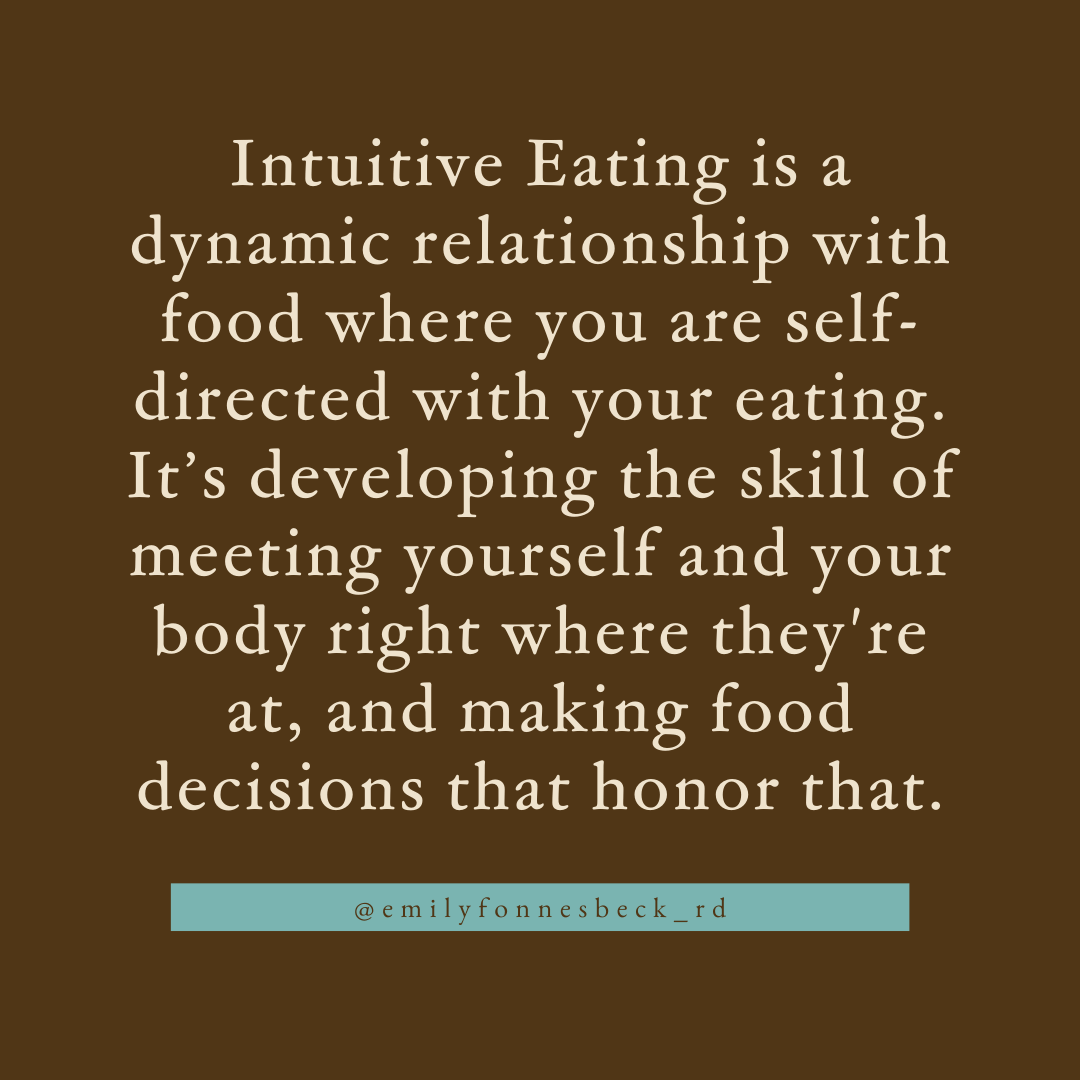
Intuitive Eating isn’t pass or fail. Instead it’s a dynamic relationship with food where you are self-directed with your eating. I like to think of IE as the ability for food to fit into your life, rather than life fitting into your food. It’s a flexible approach that allows for a natural ebb and flow in eating patterns and eating behaviors depending on the season of life you find yourself in. It’s developing the skill of meeting yourself and your body right where they’re at, and making food decisions that honor that.
I love that about Intuitive Eating. It gives us the freedom to live our lives and have our eating patterns and food choices match our circumstances… with no shame, guilt or worry about doing it “right”. After all, the “right” choice is ALWAYS circumstantial.
I hope this gives you permission to reject the pressure you feel in order to slow down and take it all in. I’d also encourage you to consider how you can adjust expectations for Intuitive Eating so you don’t feel like a failure.
I hope this has been helpful! If you have any questions you’d like me to answer in upcoming eating disorder recovery Q&As, feel free to leave a comment or send a message through my contact page! Stay tuned for more to come.